
Executive Summary
In today’s fast-paced, complex business landscape, mastering Strategic Inquiry for Leadership Success has become an essential skill. The shift from seeking answers to crafting intelligent questions is now more critical than ever, as leaders navigate uncertainties and unlock their teams’ potential. Inspired by The Art of Asking Smarter Questions, this article explores five key categories of strategic inquiry—Investigative, Speculative, Productive, Interpretive, and Subjective. Each category offers a unique perspective to enhance decision-making. By mastering and balancing these question types, executives can cultivate curiosity, drive innovation, and ensure thoughtful, comprehensive leadership.
The New Leadership Paradigm: From Answers to Questions
Why the Shift is Crucial in Modern Leadership
As technological advancements and market dynamics accelerate, traditional leadership models—focused on providing answers—are becoming obsolete. In this new era, leaders must embrace a questioning mindset that prioritizes inquiry over immediate solutions. Understanding the different domains of knowledge, such as known-knowns, known-unknowns, and unknown-unknowns, is essential for navigating today’s complexities.
Leaders like Nvidia’s Jensen Huang and Citi’s Jane Fraser exemplify this shift. They recognize that true leadership lies not in managing what is known but in strategically exploring the unknowns. By focusing on the right questions, leaders can uncover blind spots, identify hidden opportunities, and drive innovation that leads to a competitive edge.
“There are known knowns; there are things we know we know. We also know there are known unknowns; that is to say we know there are some things we do not know. But there are also unknown unknowns—the ones we don’t know we don’t know.”
— Donald Rumsfeld
The Power of Strategic Inquiry in Leadership
Why Great Leaders Ask More Questions
The transition from a knowledge-based approach to one centered on strategic inquiry is driven by the increasing complexity of today’s business environment. Effective leaders understand that asking the right questions can explore the full spectrum of knowledge, from what is known to the unknowns that present both challenges and opportunities.
As Jensen Huang suggests, a leader’s role is not to have all the answers but to guide their team through uncharted territories. This approach requires humility, curiosity, and a relentless pursuit of learning—qualities that are essential for uncovering the unknowns and fostering a culture where innovative questions lead to meaningful answers.
The Five Pillars of Strategic Inquiry
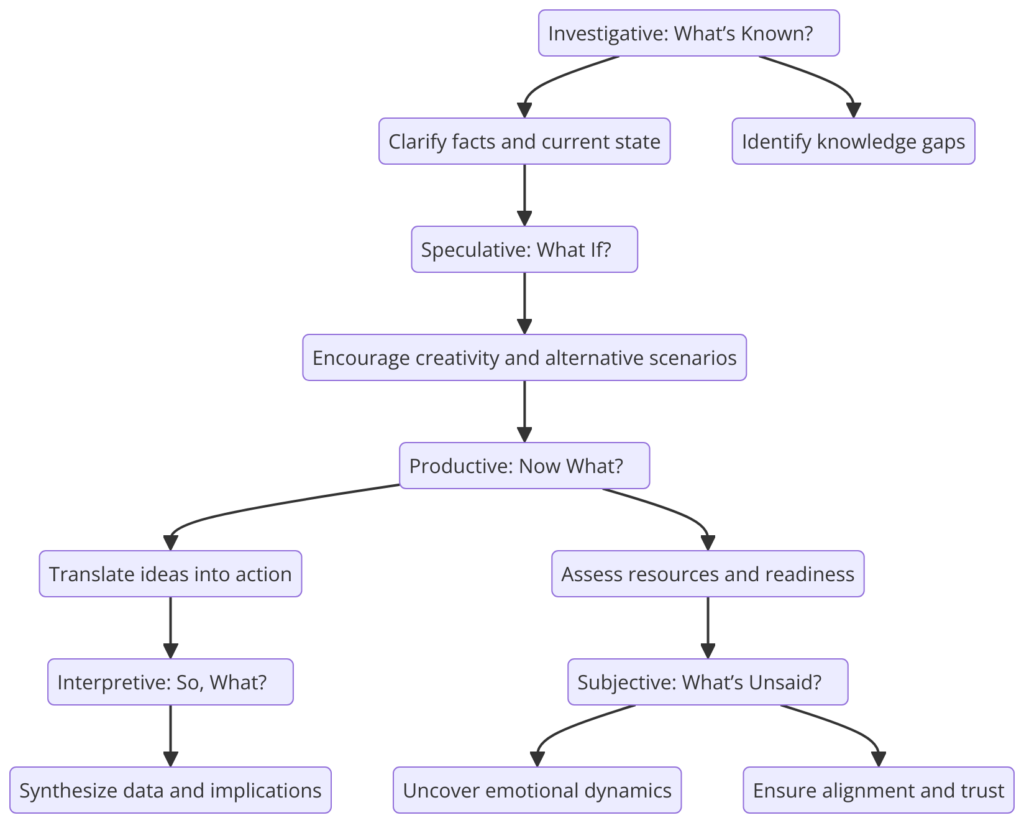
Research over the past decade has identified five distinct types of questions crucial for effective leadership and decision-making. Mastering these categories helps leaders ensure they consider all critical aspects of a decision. These questioning techniques align with the strategic decision-making methods discussed by Arnaud Chevallier, Frédéric Dalsace, and Jean-Louis Barsoux in their work.
These five categories of questions are essential tools for achieving Strategic Inquiry for Leadership Success.
1. Investigative: What’s Known?
Investigative questions form the bedrock of strategic inquiry. They help leaders uncover the facts, identify gaps in knowledge, and surface critical information that might otherwise remain hidden. These questions often revolve around understanding the current state of affairs, probing into the details, and challenging assumptions to ensure a comprehensive view of the problem at hand. The goal is to move beyond surface-level understanding to expose the intricacies that could impact decision-making.
- Purpose: Clarify the current state by uncovering facts, identifying knowledge gaps, and challenging assumptions.
- Focus: Delve deep into details to ensure a comprehensive understanding and avoid costly oversights.
- Outcome: Informed decisions based on thorough exploration of all relevant information.
Example Questions:
- What happened? – Helps pinpoint the event or issue that triggered the problem.
- What is and isn’t working? – Assesses the effectiveness of current strategies or operations.
- What evidence supports our proposed plan? – Ensures decisions are backed by solid data.
Case in Point:
In 2014, French rail operator SNCF ordered 1,860 regional trains, a decision that would cost them dearly due to a failure in investigative questioning. The team did not ask whether platform measurements were standardized across all stations, leading to the discovery that many older platforms were too narrow for the new trains. The result was a €50 million error and significant delays. This oversight exemplifies how critical it is to ask probing, detailed questions that explore the full scope of a situation, especially when dealing with large-scale investments.
Supporting Insight:
Recent research published in the Harvard Business Review highlights the importance of investigative questioning in avoiding cognitive biases like confirmation bias, where individuals favor information that confirms their pre-existing beliefs. By asking “What are we missing?” or “What assumptions are we making?”, leaders can challenge their own and their team’s preconceptions, leading to more informed and effective decisions.
2. Speculative: What If?
Speculative questions are the driving force behind innovation and creativity. They encourage leaders to explore possibilities beyond the status quo by challenging assumptions, envisioning different scenarios, and considering alternative solutions. These questions are essential in environments that require adaptability and forward-thinking, as they help organizations anticipate change and prepare for various outcomes.
- Purpose: Encourage creativity by challenging existing assumptions and envisioning new possibilities.
- Focus: Explore alternative scenarios and solutions by asking “What if…?” and “How might we…?”
- Outcome: Innovation and breakthrough ideas that can redefine industry standards and competitive advantage.
Example Questions:
- What other scenarios might exist? – Encourages consideration of different outcomes.
- Could we do this differently? – Prompts innovative thinking and alternative strategies.
- What potential solutions have we not considered? – Ensures all possibilities are explored.
Case in Point:
Emirates Team New Zealand’s innovative approach during the 2017 America’s Cup showcases the power of speculative questioning. The team’s breakthrough—using pedal power instead of traditional hand cranks to operate the catamaran’s hydraulic systems—stemmed from asking, “What else could a pedal system allow?” This question opened the door to rethinking the entire design, leading to a more efficient and competitive vessel. The victory highlights how speculative questions can lead to breakthroughs that redefine industry standards.
Supporting Insight:
IDEO, a global design and innovation company, has institutionalized speculative questioning through its “How might we…?” framework. This approach has been crucial in developing creative solutions across various industries. For example, speculative questioning helped Airbnb evolve from a simple home-sharing concept to a comprehensive platform that offers diverse travel experiences. By continually asking, “What if…?” and “How might we…?”, Airbnb has remained at the forefront of the sharing economy.
3. Productive: Now What?
Productive questions focus on execution and practicality. They are essential for translating ideas into actionable steps, assessing the resources required, and ensuring that the organization is capable of implementing decisions effectively. These questions help leaders align their teams, set realistic goals, and anticipate potential obstacles, thereby increasing the likelihood of successful outcomes.
- Purpose: Translate ideas into actionable steps by assessing resources, capabilities, and timing.
- Focus: Ensure alignment, realistic goal-setting, and anticipate obstacles to successful execution.
- Outcome: Practical, executable plans that drive progress and avoid overextension.
Example Questions:
- What is the next step? – Clarifies the immediate actions required.
- Do we have the resources to move ahead? – Assesses organizational readiness.
- Are we ready to decide? – Ensures all factors are considered before making a decision.
Case in Point:
Lego’s near-collapse in the early 2000s was a direct result of neglecting productive questions. The company attempted to diversify rapidly into new product lines, such as software and clothing, without considering whether it had the capacity to manage such expansion. The result was record losses and a period of significant restructuring. It was only after asking productive questions like “What resources do we have?” and “Can we execute on these new ventures?” that Lego refocused on its core competencies, leading to a successful turnaround.
Supporting Insight:
Larry Bossidy, former CEO of AlliedSignal, was a strong advocate for productive questioning. He famously said, “Execution is the discipline of getting things done.” Bossidy’s leadership approach emphasized rigorous questioning about how strategies would be executed, which helped AlliedSignal maintain operational excellence. By consistently asking, “How can we make this happen?” and “What will it take to get this done?”, Bossidy ensured that plans were not only strategic but also executable.
4. Interpretive: So, What?
Interpretive questions are crucial for making sense of information and drawing meaningful conclusions. These questions help leaders synthesize data, contextualize insights, and evaluate the broader implications of their decisions. By asking “So, what does this mean?” or “What are the implications?”, leaders can transform raw information into actionable intelligence that drives strategic decisions.
- Purpose: Make sense of information by synthesizing data, contextualizing insights, and evaluating implications.
- Focus: Continually ask “So, what does this mean?” to transform information into actionable intelligence.
- Outcome: Strategic decisions informed by a deep understanding of the broader impact and long-term consequences.
Example Questions:
- What did we learn from this new information? – Facilitates continuous learning and adaptation.
- What should be our overarching goal? – Aligns actions with long-term objectives.
- How does this fit with that goal? – Ensures consistency between decisions and strategic goals.
Case in Point:
A high-end European car manufacturer’s failure to recognize the disruptive potential of Tesla’s all-electric sedan illustrates the dangers of weak interpretive questioning. The company fixated on minor technical flaws, such as the gap between Tesla’s door and chassis, rather than understanding the broader market implications of a well-engineered, electric vehicle that appealed to a new generation of consumers. This oversight delayed their entry into the electric vehicle market, giving Tesla a significant competitive advantage.
Supporting Insight:
The concept of “sensemaking,” as discussed by organizational theorist Karl Weick, underscores the importance of interpretive questions in leadership. Weick argues that leaders must continuously interpret and reinterpret the significance of events to navigate complex environments effectively. For instance, after the 2008 financial crisis, companies that asked interpretive questions like “What does this mean for our long-term strategy?” and “How can we adjust to these new realities?” were better positioned to survive and thrive in the post-crisis economy.
5. Subjective: What’s Unsaid?
Subjective questions delve into the emotional and interpersonal dynamics that often influence decision-making. These questions are vital for uncovering hidden concerns, managing stakeholder expectations, and ensuring alignment among team members. By addressing the unspoken issues, leaders can prevent misunderstandings and build a stronger, more cohesive organizational culture.
- Purpose: Uncover emotional and interpersonal dynamics that can influence decision-making and stakeholder alignment.
- Focus: Address unspoken concerns by asking about feelings, hesitations, and cultural sensitivities.
- Outcome: Enhanced trust, stronger alignment, and a more cohesive organizational culture.
Example Questions:
- How do you really feel about this decision? – Encourages openness and emotional honesty.
- Are there differences between what was said, what was heard, and what was meant? – Helps prevent miscommunication and misunderstandings.
- Have we consulted the right people? – Ensures all relevant perspectives are considered.
Case in Point:
British Airways’ rebranding effort in 1997, which involved replacing the British flag on its tail fins with global designs, failed largely because the leadership team did not ask subjective questions about how employees and customers would feel about the change. The decision, perceived as a betrayal of national identity, led to significant backlash, forcing the company to revert to its original branding. This example highlights how ignoring the emotional and cultural dimensions of a decision can lead to costly missteps.
Supporting Insight:
Emotional intelligence (EQ) in leadership is closely tied to the ability to ask subjective questions. Research published in the Journal of Organizational Behavior shows that leaders who actively engage in questioning the emotional undercurrents within their teams—such as asking “How do you feel about this decision?” or “Is there anything you’re hesitant to share?”—tend to foster higher levels of trust, collaboration, and employee satisfaction. For instance, during the COVID-19 pandemic, leaders who prioritized subjective questioning were more successful in maintaining team morale and cohesion despite the challenges of remote work and uncertainty.
Developing a Balanced Questioning Approach
To excel as a leader, it’s essential to cultivate a balanced questioning style that ensures all critical aspects of decision-making are addressed. This approach involves a continuous process of self-awareness, active learning, and fostering an inclusive environment where diverse perspectives thrive. By consciously balancing the types of questions you ask, you can navigate complex challenges more effectively and lead your organization to better outcomes.
Recognize Your Biases
The first step in developing a balanced questioning approach is recognizing your natural tendencies. Every leader has a preferred style of questioning—some may naturally gravitate towards investigative questions that focus on gathering detailed information, while others may lean more towards speculative questions that encourage creative thinking. However, these preferences can create blind spots if relied upon exclusively.
- Self-Reflection: Begin by reflecting on the types of questions you ask most often. Do you tend to focus on the practical aspects of “What’s next?” or are you more comfortable probing the deeper meaning with “So, what does this mean?” Understanding your default questioning style is key to identifying areas that need more attention.
- Identify Gaps: Once you’ve recognized your biases, assess where your questioning style might fall short. For example, if you primarily ask investigative questions, you might miss out on speculative opportunities that could lead to innovation. Conversely, if you’re too focused on the subjective aspects of a decision, you may overlook critical data or practical considerations.
By acknowledging these biases, you can take the first step toward a more balanced and effective questioning approach.
Challenge Yourself
After identifying your natural tendencies, the next step is to challenge yourself by actively incorporating less familiar types of questions into your leadership style. This requires a conscious effort to step outside your comfort zone and explore different modes of inquiry.
- Deliberate Practice: Start by deliberately integrating different question types into your daily interactions. For instance, if you’re more comfortable with productive questions that focus on execution, make a point of asking speculative “What if?” questions to explore new possibilities. This practice not only broadens your perspective but also encourages your team to think more creatively.
- Learning Opportunities: Seek out opportunities to learn from others who excel in different questioning styles. This could involve mentoring, attending workshops, or simply observing how other leaders approach decision-making. By exposing yourself to diverse questioning techniques, you can expand your own repertoire and become more adaptable in your leadership approach.
- Feedback and Adjustment: Regularly seek feedback from your team and peers on your questioning style. Are you missing out on certain aspects of the discussion? Are there areas where you could probe deeper or think more broadly? Use this feedback to continuously refine your approach, ensuring that you’re addressing all relevant dimensions of a problem.
Challenging yourself in this way not only enhances your own decision-making capabilities but also sets an example for your team, encouraging them to adopt a more inquisitive and comprehensive approach to problem-solving.
Create a Culture of Inquiry
The final element of developing a balanced questioning approach is creating a culture of inquiry within your organization. This involves fostering an environment where all types of questions are valued and where diverse perspectives are encouraged and respected.
- Encourage Diverse Perspectives: Actively promote an atmosphere where team members feel safe to ask questions, regardless of their role or seniority. This can be achieved by modeling inclusive behavior yourself—inviting input from everyone in the room, especially those who may hold different viewpoints. Diverse perspectives can lead to more robust discussions and better decision-making outcomes.
- Normalize Curiosity: Make curiosity a core value of your leadership and organizational culture. Encourage your team to question assumptions, explore new ideas, and challenge the status quo. This not only leads to more innovative solutions but also helps to identify potential risks or oversights before they become critical issues.
- Facilitate Open Dialogue: Create structured opportunities for open dialogue where different types of questions can be explored. This could include brainstorming sessions, regular team check-ins, or designated times for reflection and feedback. Ensure that these forums are safe spaces for honest discussion, where team members can express concerns or ideas without fear of judgment or repercussion.
By creating a culture of inquiry, you empower your team to think more critically and creatively, leading to better outcomes for your organization. A balanced questioning approach, when embedded into the fabric of your leadership style and organizational culture, not only enhances decision-making but also fosters a more engaged, innovative, and resilient team.
Assess and Improve Your Question Mix
Regularly evaluating your questioning style helps keep your decision-making process adaptive and comprehensive. A balanced mix of questions enhances both individual and team performance.
- Self-Assessment: Reflect on recent decisions to identify strengths and weaknesses in your questioning approach.
- Strategic Adjustments: Set specific goals to diversify your question mix, like incorporating more speculative or subjective inquiries.
- Leverage Team Strengths: Collaborate with team members who complement your questioning style, filling in gaps and enriching the decision-making process.
Conclusion: The Power of Inquiry in Leadership
Asking the right questions is a strategic necessity in today’s complex business environment. A balanced approach to inquiry drives smarter decision-making, fosters innovation, and builds a culture of curiosity.
- Comprehensive Decision-Making: Mastering all five types of questions—Investigative, Speculative, Productive, Interpretive, and Subjective—ensures all aspects of a decision are considered.
- Innovation and Curiosity: A culture that values inquiry leads to more innovative solutions and empowers teams to contribute their best ideas.
- Leadership Transformation: Effective inquiry shifts leadership from directing to facilitating exploration, learning, and growth, making organizations more resilient and adaptable.